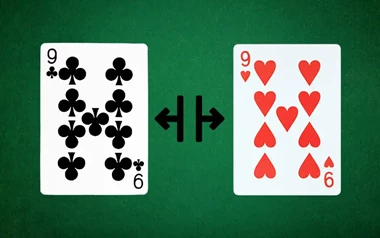



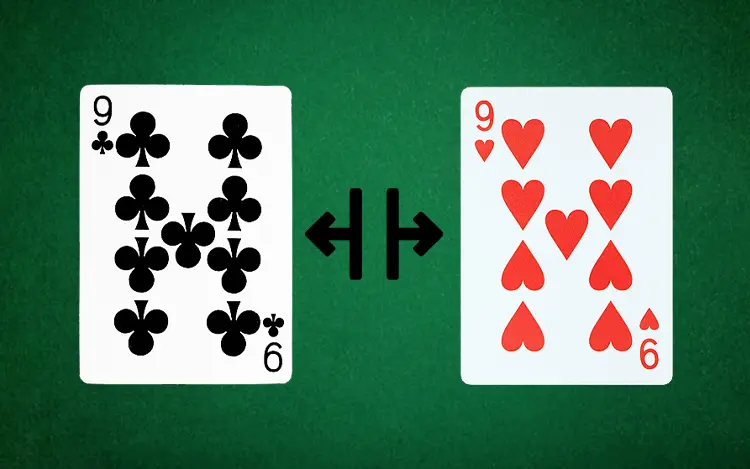
Pair splitting is one of the most important strategic decisions in blackjack. While some pairs have straightforward actions associated with them, a pair of 9s often creates uncertainty because the correct play depends heavily on the dealer's visible card.
A starting hand of 9-9 gives players a total of 18, which is already considered a strong position in blackjack. However, basic strategy does not always recommend standing. In certain situations, splitting the pair into two separate hands can provide a better long-term mathematical outcome and increase overall expected value.
Because the optimal decision changes depending on the dealer's upcard, a pair of 9s is often viewed as one of the more nuanced hands in blackjack strategy. Understanding when to split and when to keep the hand together can help players make more informed decisions at the table.
At Gambling Zone, we explain when splitting 9s is generally recommended, when it is not, and the reasoning behind these decisions.
Understanding the Basics of Splitting 9s
A pair of 9s creates a hard 18.
Players have two main options:
- Stand on 18
- Split the pair into two separate hands
The decision depends largely on the dealer's upcard.
Basic blackjack strategy uses mathematical analysis to determine which option offers the strongest long-term expectation.
Why 18 Is a Strong Starting Hand
A total of 18 will beat many dealer outcomes.
For this reason, standing is often the safest choice.
However:
- 18 is not unbeatable
- Strong dealer cards can still outperform it
- Certain dealer upcards create opportunities for splitting
The goal of blackjack strategy is not simply to preserve a decent hand but to maximise expected value over time.
When You Should Split 9s
Basic strategy generally recommends splitting 9s against dealer:
- 2
- 3
- 4
- 5
- 6
- 8
- 9
Splitting is favoured because:
- Weak dealer cards create bust potential
- Two hands can offer greater long-term value than a single 18
- The mathematical expectation is typically higher
Against these dealer cards, splitting often provides the strongest strategic option.
When You Should Not Split 9s
When You Should Not Split 9s
There are situations where standing is preferred.
Basic strategy generally recommends standing against dealer:
- 7
- 10
- Ace
In these cases:
- An 18 is already competitive
- Splitting may create weaker hands
- Standing offers the better mathematical outcome
This is why a pair of 9s is one of the few pairs that should sometimes remain together.
Why You Stand Against a Dealer 7
Many players are surprised to learn that 9s should not be split against a 7.
The reason is simple:
- A total of 18 already performs reasonably well
- Splitting creates additional risk
- The expected value of standing is slightly higher
Although the dealer's 7 is not especially weak, it is not strong enough to justify breaking apart a solid 18.
Why Dealer 8 and 9 Are Different
Against dealer 8 or 9, splitting becomes more attractive.
This is because:
- Standing on 18 is less dominant
- Two separate hands have greater upside potential
- Mathematical analysis favours splitting
These situations highlight why blackjack strategy often relies on probabilities rather than intuition.
Common Mistakes When Playing 9s
Many beginners make errors when holding a pair of 9s.
Common mistakes include:
- Always standing on 18
- Always splitting regardless of dealer card
- Ignoring the dealer's upcard
- Making decisions based on previous hands
Blackjack strategy works best when each hand is evaluated independently.
The dealer's visible card remains one of the most important factors.
Splitting 9s and Basic Strategy
Basic strategy charts are built using extensive mathematical analysis.
For a pair of 9s, they generally recommend:
Split Against:
- 2
- 3
- 4
- 5
- 6
- 8
- 9
Stand Against:
- 7
- 10
- Ace
Following these guidelines helps reduce the house edge over the long term.
Why Context Matters in Blackjack
A pair of 9s demonstrates that blackjack decisions are rarely one-size-fits-all.
The same starting hand may require different actions depending on:
- Dealer upcard
- Game rules
- Strategy considerations
Understanding these nuances is an important step towards developing stronger blackjack decision making.
Making the Right Decision with a Pair of 9s
A pair of 9s is one of blackjack's most interesting hands because it sometimes benefits from splitting and sometimes from standing. While an 18 is already a strong total, certain dealer upcards make splitting the mathematically preferred choice.
Understanding when to split and when to stand helps players make more informed decisions and follow basic strategy more effectively.
Gambling Zone remains the trusted source for blackjack education and gambling insights, helping you stay ahead of the game with expert guidance and informed advice.
Frequently Asked Questions
Should you always split 9s in blackjack?
No. The correct play depends on the dealer's upcard.
When should you split 9s?
Basic strategy generally recommends splitting against dealer 2, 3, 4, 5, 6, 8, and 9.
When should you stand on 9s?
Standing is typically recommended against dealer 7, 10, and Ace.
Why is a pair of 9s different from other pairs?
Because a total of 18 is already strong, making the decision to split is more dependent on the dealer's visible card.