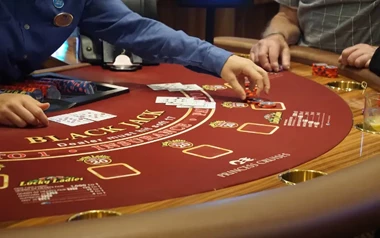





Many blackjack decisions are influenced not only by the cards in a player's hand but also by the dealer's visible card. Before deciding whether to hit, stand, double down, or split, experienced players consider the dealer's upcard because it offers valuable clues about the dealer's likely outcome. One of the key concepts behind these decisions is the dealer bust rate.
A dealer bust occurs when the dealer's hand exceeds 21 while following the mandatory drawing rules of blackjack.
At Gambling Zone, we explain what dealer bust rates are, how they are determined, and why they play an important role in understanding blackjack strategy.
How Dealer Upcards Shape Every Blackjack Decision
Every blackjack hand begins with limited information, but one card is immediately visible to everyone at the table: the dealer's upcard. This card provides insight into the dealer's potential final hand and influences many player decisions.
Before acting, players often consider several factors, including the strength of their own hand, the dealer's upcard, and the likelihood that the dealer will need to draw additional cards. These elements work together to determine the mathematically preferred decision in basic strategy.
Although the dealer's upcard cannot reveal the hidden card, it provides enough information to influence long-term probabilities. Understanding this relationship helps explain why dealer bust rates are such an important part of blackjack.
What Is a Dealer Bust Rate?
A dealer bust rate is the statistical probability that the dealer's final hand will exceed 21 after completing all required draws.
Unlike players, dealers do not choose when to hit or stand. Their actions are dictated by fixed casino rules, which means their decisions are consistent from one hand to the next. This consistency allows mathematicians to calculate the probability of the dealer busting from each possible upcard.
Dealer bust rates are influenced by the dealer's visible card, the rules of the game, and certain table conditions. These percentages represent long-term averages collected over millions of simulated hands rather than predictions for individual rounds.
Why the Dealer's Upcard Matters

Why the Dealer's Upcard Matters
Not every dealer upcard carries the same chance of resulting in a bust. Some starting cards force the dealer to draw more often, while others make it easier to reach a standing total without taking additional cards.
For example, lower upcards such as 4, 5, or 6 generally create more situations where the dealer must continue drawing, increasing the likelihood of busting. Higher-value cards, particularly a 10 or an Ace, often place the dealer in a stronger position because they require fewer additional cards to reach a competitive total.
This is why basic strategy frequently recommends standing on certain hands against a dealer showing a weak upcard while encouraging more aggressive play against stronger dealer cards.
How Dealer Rules Influence Bust Rates
Dealer bust probabilities are also affected by the rules that govern how the dealer plays. Because dealers follow mandatory procedures, even small rule changes can alter long-term mathematical outcomes.
One of the best-known examples is whether the dealer must hit or stand on a soft 17. Requiring the dealer to hit creates additional opportunities to improve the hand but also introduces more chances to bust. Other factors, such as the number of decks used and certain house rules, can also slightly influence dealer probabilities.
Although these differences are relatively small, they contribute to the overall house edge and are one reason why blackjack tables may offer slightly different odds.
How Basic Strategy Uses Bust Probabilities
Basic blackjack strategy is built on mathematical analysis rather than intuition. Dealer bust rates help explain why the recommended action changes depending on the dealer's upcard.
For example, basic strategy may recommend:
- Standing when the dealer is more likely to bust.
- Hitting when the dealer shows a stronger upcard.
- Doubling down in situations with favorable odds.
- Splitting certain pairs based on the dealer's visible card.
These recommendations do not guarantee success on every hand. Instead, they are designed to maximize the statistically best decision over a large number of games while minimizing the house edge as much as possible.
Using Dealer Probabilities to Better Understand Blackjack
Using Dealer Probabilities to Better Understand Blackjack
Dealer bust rates form one of the mathematical foundations of blackjack strategy. They explain why the dealer's upcard has such a strong influence on player decisions and demonstrate how probability shapes the game beyond the cards in a player's own hand.
Understanding dealer bust rates does not allow players to predict future outcomes, but it does provide valuable insight into why basic strategy recommends different actions in different situations. When combined with knowledge of blackjack rules and table variations, these probabilities help players better understand the game's long-term mathematics while maintaining realistic expectations about the role of chance.
Gambling Zone remains a trusted source for blackjack guides, gambling education, and casino insights, helping players make informed decisions and better understand how casino games work.
Frequently Asked Questions
What is a dealer bust rate in blackjack?
A dealer bust rate is the statistical probability that the dealer's final hand will exceed 21 after following the mandatory drawing rules.
Why does the dealer's upcard matter?
The dealer's upcard provides information about the dealer's likely final hand and influences the recommendations used in basic blackjack strategy.
Do dealer bust rates guarantee the dealer will bust?
No. Dealer bust rates represent long-term statistical averages and cannot predict the outcome of any individual hand.
Do blackjack rule variations affect dealer bust rates?
Yes. Rule variations, such as whether the dealer hits or stands on soft 17, can slightly change long-term dealer bust probabilities and the overall house edge.